Saudade (Portuguese): a longing for something absent and loved, held together with the memory of it.
Saudade can be translated. It takes English a whole sentence, but it can be done, and the story of why everyone insists otherwise is better than the claim.
Open almost any list of "untranslatable words" and saudade sits near the top, usually under a photo of a sunset. The claim sounds like something the internet came up with last Tuesday. It's actually more than 400 years old, and it started life as a boast.
The 1606 boast
In his 1606 book on the Portuguese language, Duarte Nunes de Leão defined saudade as the memory of something, together with the desire for it. Then he added a flourish. The word, he insisted, was specifically Portuguese.
Fair enough. Most of us feel the same way about a family recipe. But people kept repeating his line for four centuries, and somewhere along the way a proud writer's aside hardened into a fact. So when a list tells you saudade can't be translated, it's quoting 1606 without knowing it.
Memory and desire at the same time
The old definition has two halves, and the word needs both. Memory looks back while desire leans forward, and saudade is the feeling of doing both about the same absent thing.
English can cover each half on its own. Nostalgia does the remembering and longing does the wanting. You need both words, plus a bit of glue, to get what Portuguese packs into one.
Saudade has cousins. Welsh has hiraeth, a longing and grief for what's gone, often a homesickness for a Wales that never quite existed. Russian has toska, which the linguist Anna Wierzbicka sets beside the English word "sad" to show how differently two languages can slice up a feeling. Both turn up on the same lists, wearing the same "untranslatable" badge.
English speakers feel it too
You might reasonably push back here and say that a missing word must mean a missing feeling.
The strong version of that idea, that a missing word means a missing thought, finds no support in the sources below. The milder version holds up. Words nudge what we notice and how quickly we notice it. They don't decide what we're able to feel.
The writer Guy Deutscher, in Through the Language Glass (2010), popularized a neat way of putting this, known as the Boas-Jakobson principle: languages differ mainly in what they must say, not in what they can say. English can say saudade. It just needs a sentence where Portuguese uses a word: I remember it, I miss it, and I want it back.
A 2019 paper in Science compared emotion words across 2,474 languages and found real differences between language families. It also found a shared base. Every family sorts feelings mostly by whether they're pleasant or unpleasant, and by whether they're calm or stirred up. The feelings underneath are shared and each language carves the top layer its own way, so the ache saudade names doesn't belong to Portugal.
English has been through this before. When schadenfreude turned up in English in the mid-nineteenth century, Richard Chenevix Trench (later an archbishop) wrote in 1853 that it was "a linguistic token of sin". These days English speakers use it without blinking, and anyone who has watched a neighbor's leaf blower die halfway across the lawn knows the feeling was there long before the word.
What a name does for a feeling
A name gives a feeling somewhere to sit. The psychologist Lisa Feldman Barrett argues that the brain builds emotions partly from learned concepts, and that words help us learn them. On that view, meeting the word saudade gives you a new drawer for something you already owned.
There's some lab evidence for naming, too. In a 2007 brain-scan study by Lieberman and colleagues, people who labeled the emotion on a face ("angry") showed less activity in the amygdala than people who labeled the face with a name ("Harry"). The effects were small, and no study has shown that learning a foreign feeling-word makes anyone better at feelings. We'd still rather have the word than not.
A small correction
Next time someone tells you saudade is untranslatable, enjoy the word and adjust the claim: it has no one-word equivalent in English. That's a smaller statement and a truer one.
Duarte Nunes de Leão might not thank us for it. He was talking about his own language, and he had every right to show off.
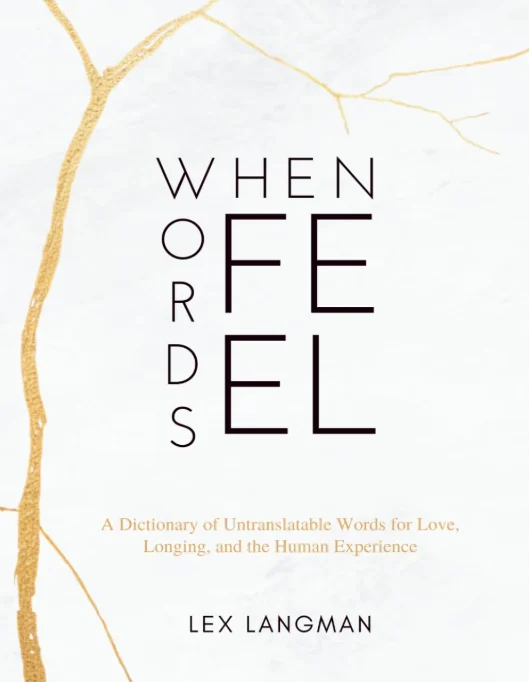
Saudade has a page in Volume I of When Words Feel: Illustrated Edition by Lex Langman, coming soon, in the chapter The Heart's Terrain. The original When Words Feel is out now in hardcover.
Sources
- Saudade (Wikipedia)
- Oseki-Dépré, "La Saudade" (2008, OpenEdition; reports the 1606 passage)
- Hiraeth (Wikipedia)
- Wierzbicka, Emotions across Languages and Cultures (1999), front matter
- Deutscher and McWhorter, review (LA Review of Books)
- Jackson et al. 2019, Max Planck press release
- Schadenfreude history (QMUL History of Emotions)
- Theory of constructed emotion (Wikipedia)
- Hoemann, Xu and Barrett, words and emotion learning
- Lieberman et al. 2007